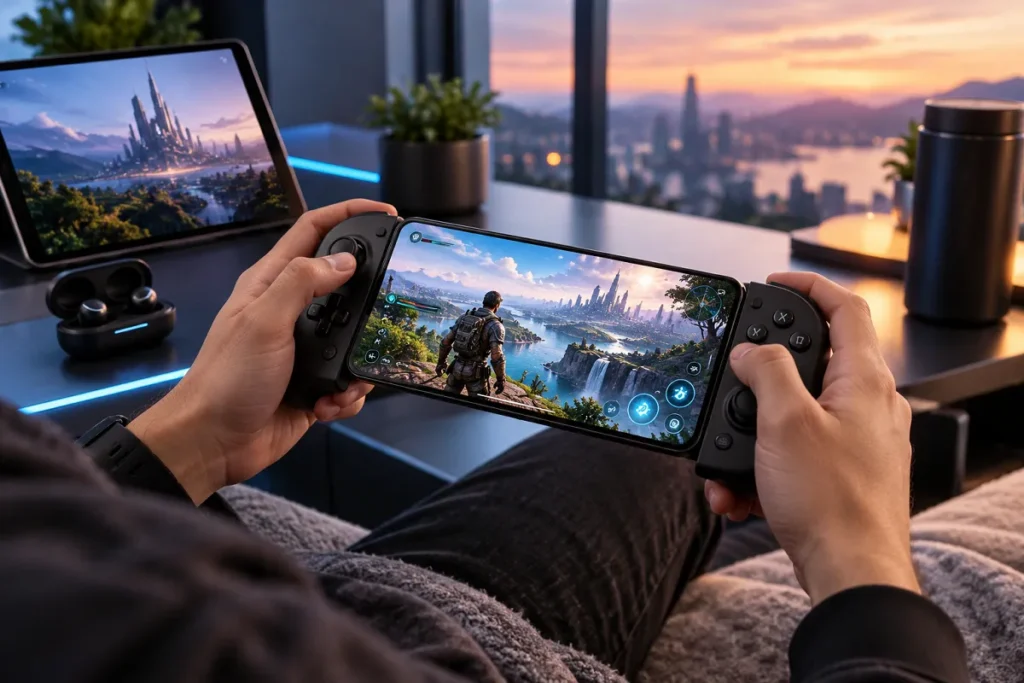
The phrase wavetechglobal mobile tech changed gaming reflects a much broader transformation happening across the gaming industry. Smartphones are no longer limited to simple puzzle games or short casual experiences. Better processors, powerful mobile GPUs, faster wireless connections, cloud gaming, AI-assisted graphics, and dedicated gaming accessories have turned phones and handheld devices into serious gaming platforms. WaveTechGlobal covers technology, smartphones, gaming, and related digital trends. Its discussion of mobile gaming fits into a wider industry shift in which mobile devices are becoming capable of experiences once associated mainly with PCs and consoles.
Mobile Hardware Has Become Powerful Enough for Serious Gaming
One of the biggest reasons mobile gaming has changed is simple: phones have become dramatically more powerful.
Modern mobile processors combine high-performance CPU cores, advanced GPUs, dedicated AI hardware, and improved memory systems in a single compact chip. These improvements allow developers to create richer environments, higher-quality lighting, better physics, and smoother animation.
Qualcomm’s latest Snapdragon gaming technologies, for example, support hardware-accelerated ray tracing, advanced graphics rendering, high frame rates, and Unreal Engine 5 features on mobile devices. Its Snapdragon 8 Elite Gen 5 platform also claims a 23% improvement in GPU performance and 20% better GPU power efficiency compared with its previous generation.
These advances matter because gaming performance is not only about maximum speed. A phone also needs to maintain that performance without overheating or draining its battery too quickly.
Better Graphics Without a Gaming PC
Mobile graphics have moved far beyond the basic visual effects associated with earlier smartphone games.
Hardware-accelerated ray tracing can create more realistic reflections, shadows, and lighting. Technologies such as mesh shading and AI-assisted rendering can also help developers produce detailed scenes without placing the same workload on the GPU.
Qualcomm says its current gaming platform supports technologies including ray tracing, Unreal Engine 5, AI-powered super resolution, and frame-generation techniques.
That means the visual gap between smartphones, handheld gaming systems, consoles, and PCs is becoming smaller for some types of games.
High Refresh Rates Made Mobile Gaming Feel Faster
Graphics quality is only part of the experience.
Competitive players also care about responsiveness.
Screens running at 90Hz, 120Hz, or 144Hz can display movement more frequently than traditional 60Hz panels. When the game and hardware can produce matching frame rates, scrolling, aiming, racing, and fast combat can feel considerably smoother.
Dedicated mobile gaming platforms are now designed around this expectation. Qualcomm’s Snapdragon G3 Gen 3 platform, for example, supports QHD+ gaming at up to 144Hz and includes Wi-Fi 7 and optional 5G connectivity.
This is an important part of how wavetechglobal mobile tech changed gaming as a broader concept: mobile hardware is increasingly designed around gaming performance rather than treating gaming as an additional phone feature.
Cloud Gaming Changed What a Phone Can Play

A smartphone does not always need to render the game itself.
Cloud gaming allows much of the processing to happen on remote servers. The video is streamed to the user’s device while controller commands are sent back over the internet.
This approach can give smartphones and lightweight handheld devices access to games that would normally require more powerful hardware.
Microsoft continues to develop Xbox Cloud Gaming for supported browsers and devices, while dedicated Snapdragon gaming handhelds are designed to work with services such as Xbox Cloud Gaming, GeForce NOW, PlayStation services, and Steam Link.
Cloud gaming therefore changes the role of the phone. Instead of being only a platform for native mobile games, it can also become a screen and controller interface for PC- and console-style experiences.
The main limitation remains network quality. Latency, unstable Wi-Fi, bandwidth restrictions, and data costs can affect the experience.
Mobile Gaming Is Now a Huge Entertainment Market
The technical improvements would matter less if people were not actually playing.
Mobile gaming remains one of the largest parts of the games industry.
Sensor Tower reported that mobile games generated approximately $82 billion in in-app purchase revenue during 2025. It also reported that mobile games were being downloaded at an average rate of roughly 95,000 downloads per minute during the year.
The numbers help explain why developers continue investing in better smartphone graphics, live-service systems, cross-platform accounts, controllers, cloud services, and mobile-first gameplay.
Instead of functioning as a secondary gaming market, mobile has become a central part of the industry.
Physical Controllers Improved Mobile Gameplay
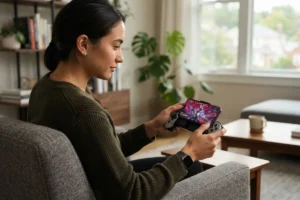
Touchscreens are convenient, but they are not ideal for every game.
Virtual buttons can cover part of the display, and they do not provide the tactile feedback of physical sticks and triggers.
Modern Bluetooth and USB-C controllers solve much of this problem. Some accessories turn a smartphone into a handheld-style device by placing controls on both sides of the screen.
This is especially useful for:
- racing games;
- shooters;
- action RPGs;
- platformers;
- emulated games;
- remote play;
- cloud gaming.
Dedicated gaming handhelds are also becoming more sophisticated. Devices using platforms such as Snapdragon G3 Gen 3 combine mobile processors with physical controls, active cooling, high-resolution displays, and gaming-focused software.
AI Is Starting to Influence Mobile Gaming
Artificial intelligence is another major development.
On-device AI can contribute to graphics enhancement, frame generation, performance optimization, voice processing, and other gaming features without constantly sending information to remote servers.
Qualcomm’s newer mobile platforms use AI-assisted techniques such as super resolution and neural graphics processing to improve visual quality while managing power consumption.
For developers, AI could eventually support smarter non-player characters, adaptive difficulty, improved procedural environments, and more efficient content creation.
However, these possibilities depend on how individual game studios implement the technology.
Battery Life and Heat Remain Important Challenges
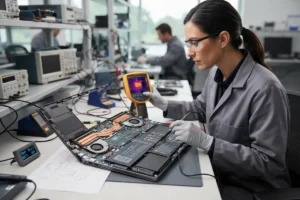
More performance creates another problem: energy consumption.
High frame rates, maximum brightness, constant wireless connections, and demanding graphics can quickly consume battery power. Intensive gaming also produces heat, and sustained heat can force a device to reduce performance.
That is why modern gaming chips increasingly focus on performance per watt rather than raw speed alone.
For players, practical improvements such as efficient processors, larger batteries, cooling systems, optimized game settings, and variable refresh rates can be just as valuable as higher benchmark scores.
What “WaveTechGlobal Mobile Tech Changed Gaming” Really Means
The strongest interpretation of wavetechglobal mobile tech changed gaming is not that one technology suddenly transformed the entire gaming industry.
The transformation comes from several technologies developing together.
Faster mobile processors make demanding games possible. Advanced GPUs improve graphics. High-refresh displays make gameplay smoother. 5G and Wi-Fi technologies support connected experiences. Cloud gaming expands the available game library. Physical controllers improve precision, while AI increasingly helps balance graphics quality and efficiency.
Together, these changes have transformed the smartphone from a casual gaming device into a flexible gaming platform.
Mobile will not completely replace PCs or consoles. Those platforms still offer advantages in sustained performance, large-screen experiences, upgradeability, and specialized controls.
But the dividing line between mobile, console, PC, and cloud gaming is becoming much less clear.
FAQs
How has mobile technology changed gaming?
Mobile technology has made gaming more portable, accessible, graphically advanced, connected, and compatible with cloud platforms and physical controllers.
Can modern phones run console-quality games?
Some premium smartphones can run highly sophisticated games and console ports, although performance, graphics settings, cooling, and game availability vary by device.
What role does 5G play in mobile gaming?
5G can provide faster connectivity and lower network latency in suitable conditions, which can benefit multiplayer and cloud gaming.
Is cloud gaming the same as mobile gaming?
No. Native mobile games run mainly on the device, while cloud games are processed remotely and streamed to the phone or tablet.
Will mobile gaming replace consoles?
Probably not entirely. Mobile, PC, consoles, handhelds, and cloud gaming increasingly complement one another and serve different player needs.
For any suggestions or changes, please feel free to contact us.