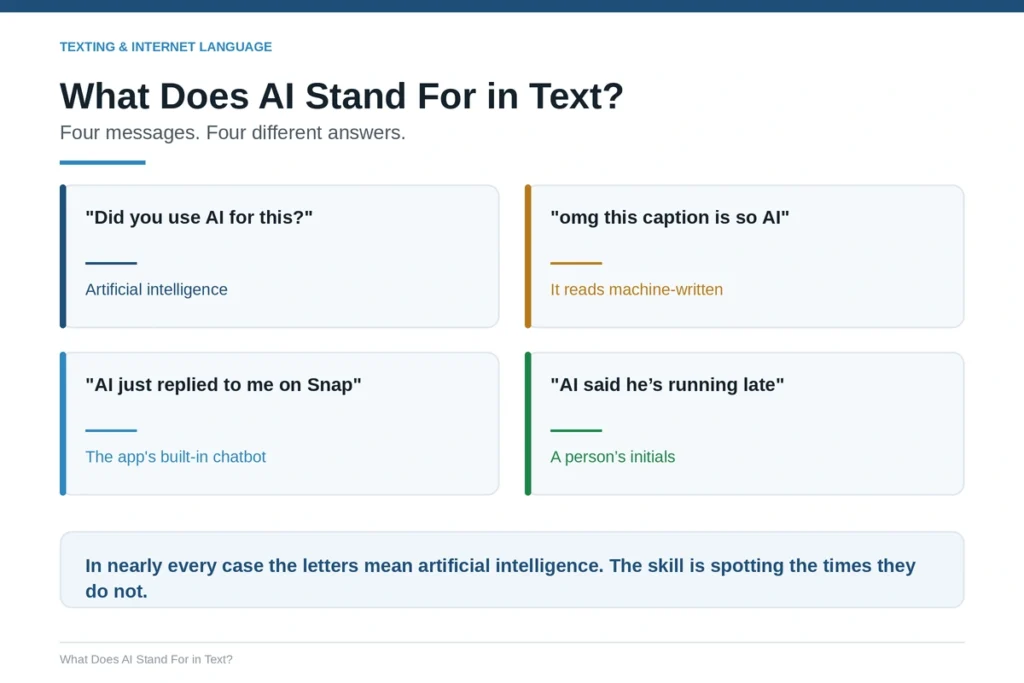
“Did you use AI for this?” means artificial intelligence. “omg this caption is so AI” means the caption reads as machine-written. “AI just replied to me on Snap” means the app’s built-in chatbot. And “AI said he’s running late” almost certainly means a person whose initials are A.I. So what does AI stand for in text? In nearly every case, artificial intelligence. The confusion is not about the definition; it is about the job those two letters are doing in one specific sentence. They can name a technology, insult a piece of content, label a product, or identify a human being. This guide separates the meanings that are real and documented from the ones thin slang pages have invented, and gives you a three-second test that resolves almost every message.
What Does AI Stand For in Text? The Short Answer
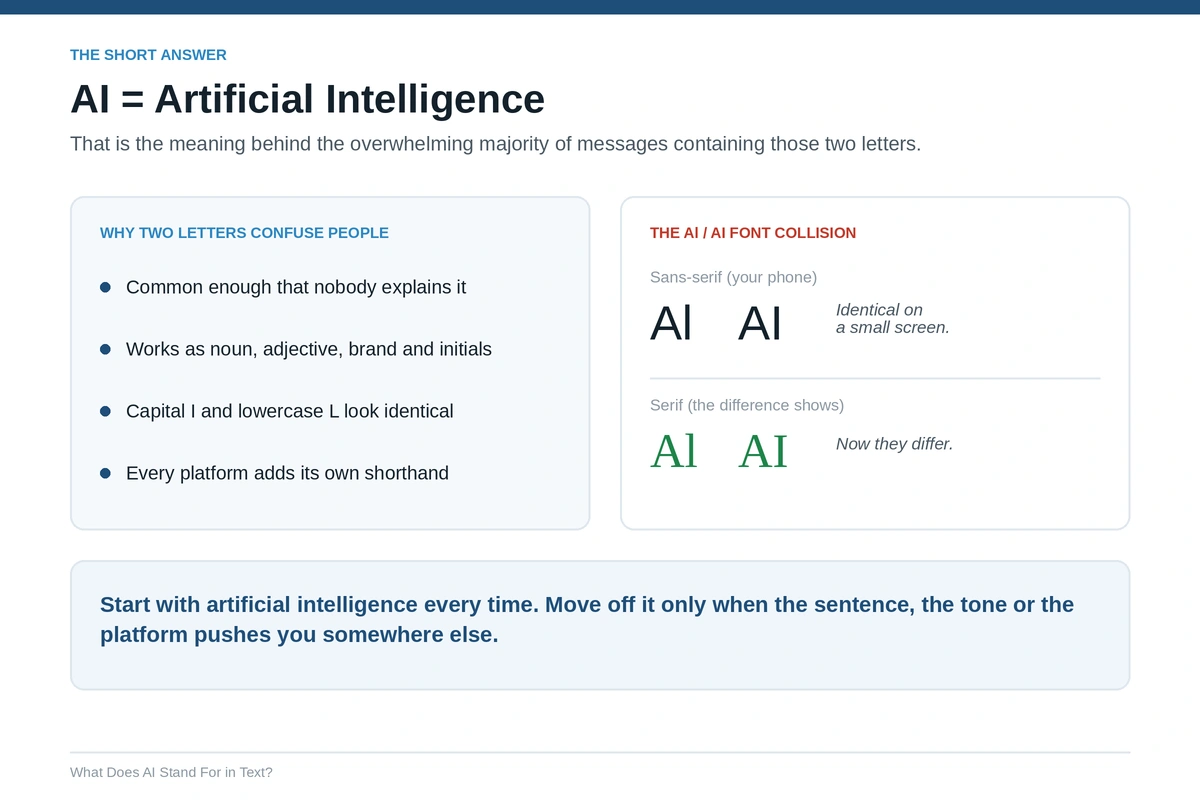
AI stands for artificial intelligence. That is the meaning behind the overwhelming majority of messages containing those letters, in group chats, DMs, comment sections, dating apps, and work threads alike.
Everything else is a minority case. But the minority cases are exactly the ones that trip people up, because they arrive without warning and read perfectly naturally.
Why two letters cause this much trouble
Three things stack on top of each other.
- The abbreviation is now common enough that people type it without explaining it.
- The same letters serve as a noun, an adjective, a brand name, and a set of initials.
- A capital I and a lowercase L are visually identical in most phone fonts.
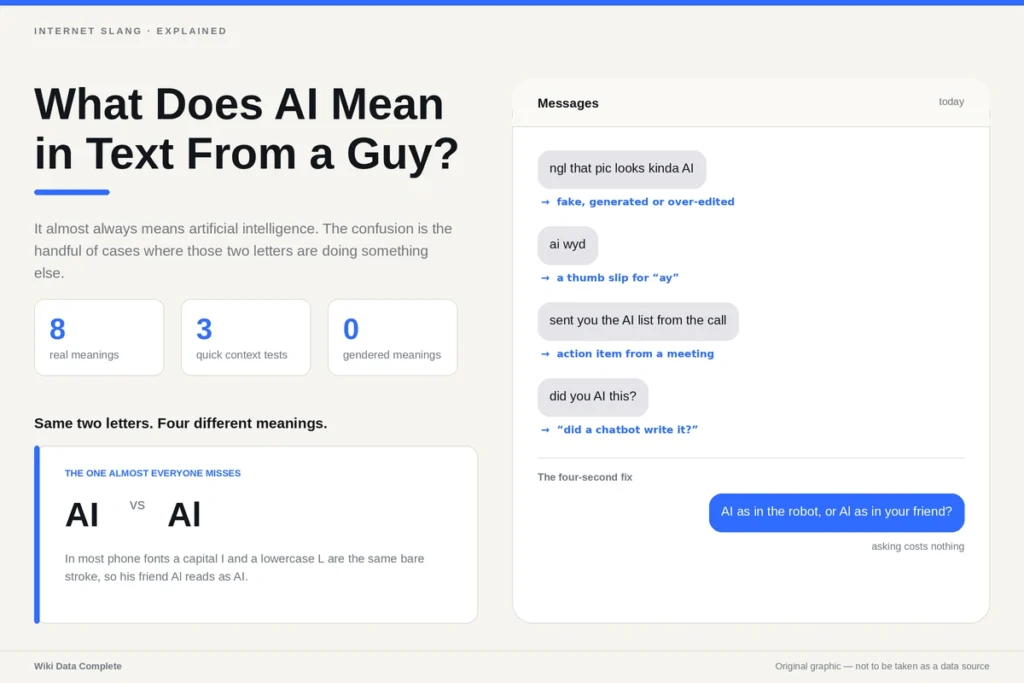
That last one is worth pausing on. In Helvetica, Arial, Roboto, and the SF font on iPhones, “Al”, short for Alan, Alex, or Albert, renders as a capital A followed by a vertical bar. It is indistinguishable from “AI” on a small screen. Switch the message to a serif font and the difference appears instantly. A surprising share of “why is my friend texting me about AI” moments are actually a friend named Al.
Artificial Intelligence: The Default Meaning
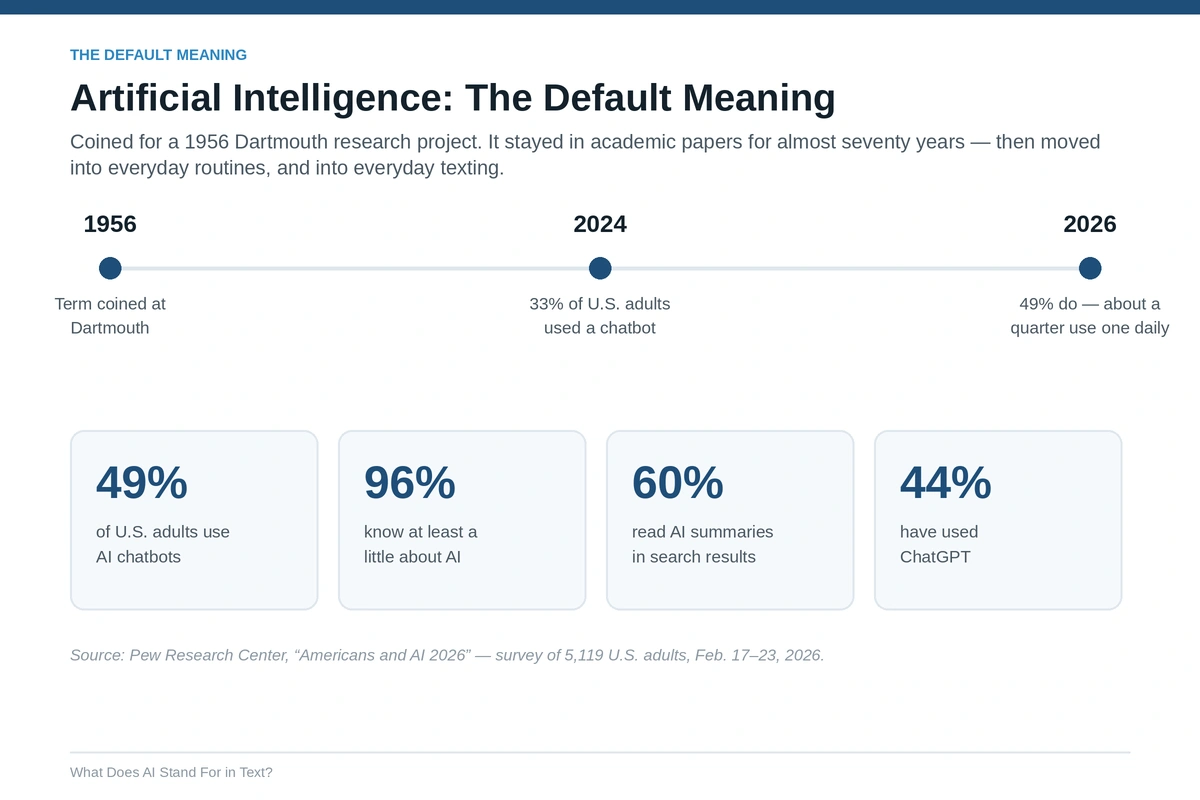
Start here every time. Unless the sentence pushes you elsewhere, assume the technology.
Where the term came from
The phrase was coined for a research proposal. John McCarthy used “artificial intelligence” to name a summer research project held at Dartmouth College in 1956, and the label stuck to the entire field. For most of the following seventy years it lived in academic papers and science fiction, not text messages.
What changed between 2023 and 2026
The letters entered casual conversation because the tools entered daily routines.
Pew Research Center surveyed 5,119 U.S. adults in February 2026 for its “Americans and AI 2026” report. Roughly half, 49%, said they use AI chatbots, up from 33% in 2024. About a quarter use one daily. Nearly all adults, 96%, said they know at least a little about AI, and 60% said they read AI-generated summaries at the top of search results.
When half a country uses something every week, they stop spelling it out. That is how “artificial intelligence” became two letters in a group chat.
The Four Jobs “AI” Does in a Real Message
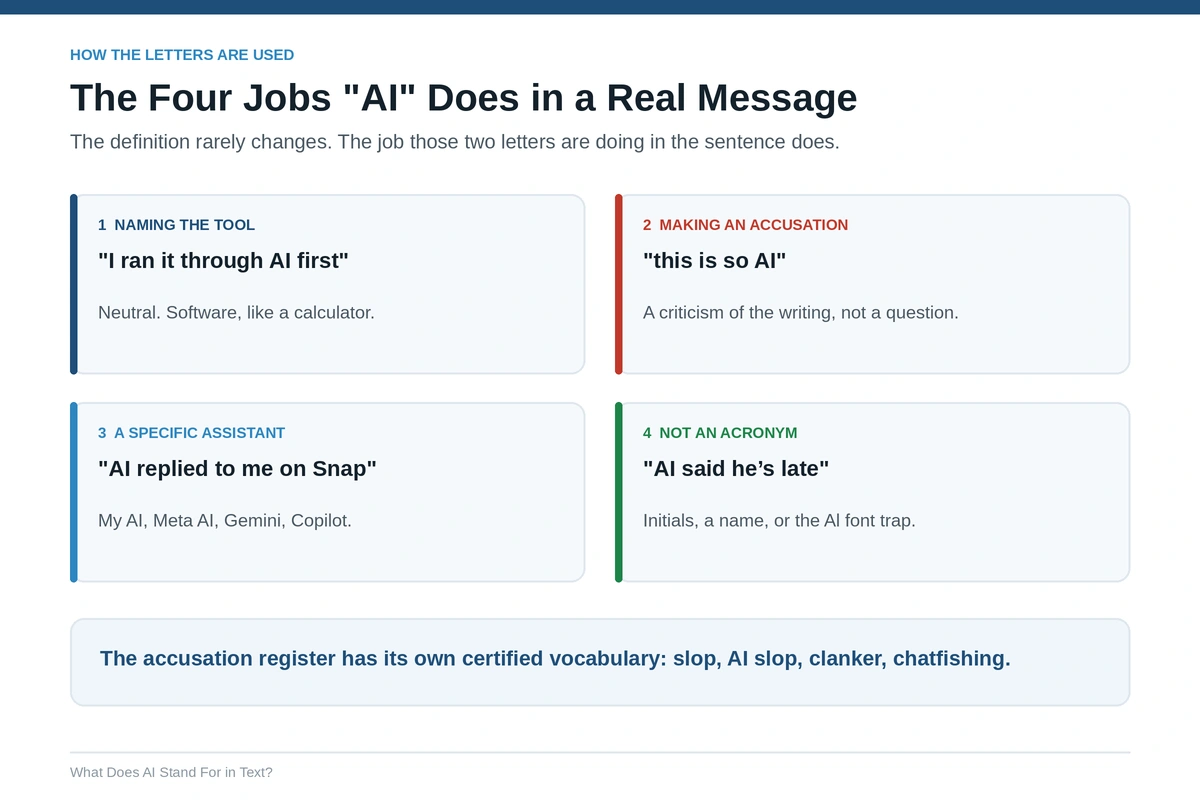
Once you accept that the letters mean artificial intelligence, you still have to work out what the sender is doing with them. There are four recurring patterns.
1. Naming the tool
“I ran it through AI first.” “AI wrote the outline, I fixed it.” “Just ask AI.”
Neutral and descriptive. The sender is referring to software the way they would refer to a calculator or a search engine. No judgment attached, and none expected in your reply.
2. Making an accusation
“This is so AI.” “That email was AI, I can tell.” “Your text sounded AI-generated ngl.”
Here, AI is functioning as an adjective, and the meaning is closer to generic, hollow, or machine-made. It is a criticism of the writing, not a question about the technology. Replying with an explanation of large language models will miss the point entirely.
The vocabulary that grew up around the accusation
This register has its own words now, and dictionaries have started certifying them.
- Slop: Merriam-Webster named it Word of the Year for 2025, defining it as low-quality digital content produced in quantity by artificial intelligence. Australia’s Macquarie Dictionary picked the fuller phrase “AI slop” as both its committee and people’s choice.
- Clanker: A derogatory term for an AI system or robot, borrowed from Star Wars and revived on TikTok. Macquarie gave it an honourable mention in the same 2025 selection.
- Chatfishing: Using a chatbot to write your half of a conversation while presenting it as your own, most often discussed in online dating. The term is a deliberate echo of catfishing.
If someone texts “stop chatfishing me” or calls a customer service line a clanker, they are speaking this dialect. The subject is authenticity, not technology.
3. Pointing at one specific assistant
Sometimes “AI” is shorthand for a named product the sender assumes you also use. Context makes the referent obvious to them and invisible to you.
On Snapchat, “AI” almost always means My AI, the chatbot pinned inside the chat list. Inside Instagram, WhatsApp, or Messenger, it usually means Meta AI. In a work thread, it is probably Copilot or Gemini. Pew’s 2026 figures show ChatGPT reaching 44% of U.S. adults, Gemini 24%, Copilot 17%, and Meta AI 14% — which is why “AI” without a name still lands most of the time.
4. Not an abbreviation at all
Three non-acronym cases show up regularly.
- A.I. is a normal set of initials. A contact saved as “AI” in someone’s phone will appear that way in every screenshot they send you.
- A given name. Ai is a common Japanese, Chinese, and Vietnamese name, pronounced like the English word “eye.” Written in all caps in a message header, it reads as the acronym.
- The Al collision. The font problem described earlier. If the message would make sense with a person’s name in that slot, it probably is one.
Non-Technology Meanings Worth Knowing
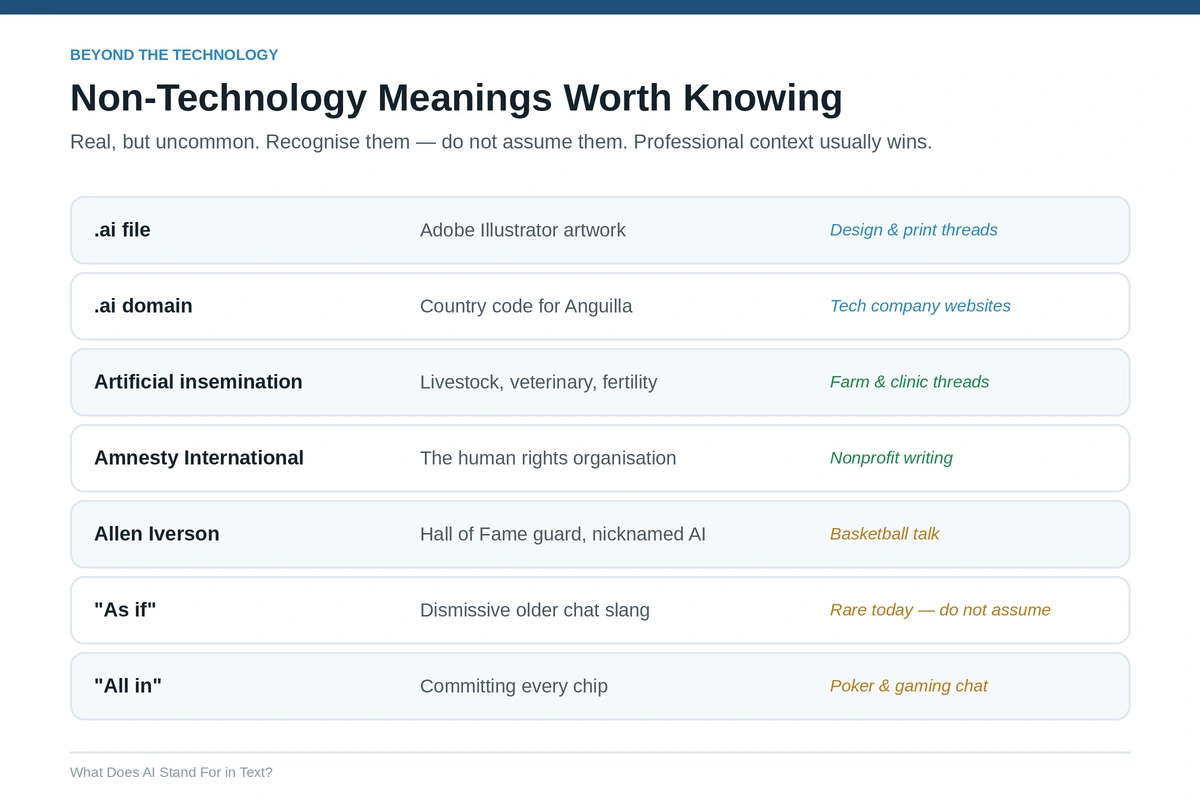
These are real but uncommon. Recognize them; do not assume them.
“As if”
Long-running internet slang references, including NetLingo and Slang.net, record AI as shorthand for “as if”, a dismissive expression of disbelief, roughly equivalent to “yeah, right.”
The usage is genuine, but it belongs to an older era of instant messaging and appears rarely today. In 202,6 the odds that a stray “AI” means “as if” are low, and they drop further if the sender is under thirty. Read it as a possibility, not a default.
“All in”
In poker forums and gaming chat, AI is written shorthand for all-in, committing every chip to a hand. You will see it in strategy posts and hand histories far more often than in text messages, and only among players.
Field-specific meanings
If the conversation has a professional context, that context usually wins.
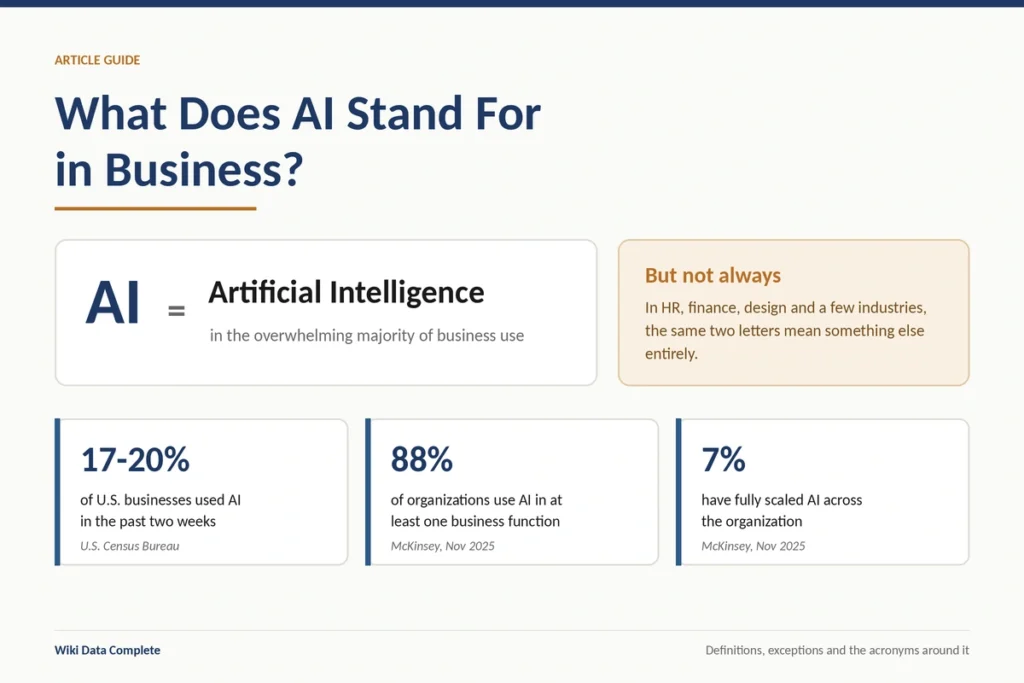
- .ai file: The Adobe Illustrator format. Designers and print shops trade these daily. “Send me the AI” is a file request, not a robot request.
- .ai domain: The country-code top-level domain assigned to Anguilla, adopted en masse by technology companies for obvious reasons.
- Artificial insemination: Standard usage in agriculture, veterinary medicine, and fertility care. In a livestock or clinic thread, this is the meaning.
- Amnesty International: The common abbreviation in human rights and nonprofit writing.
- Allen Iverson: The Hall of Fame guard, known as AI throughout his career. Basketball conversation only.
The Three-Second Test for Any Message
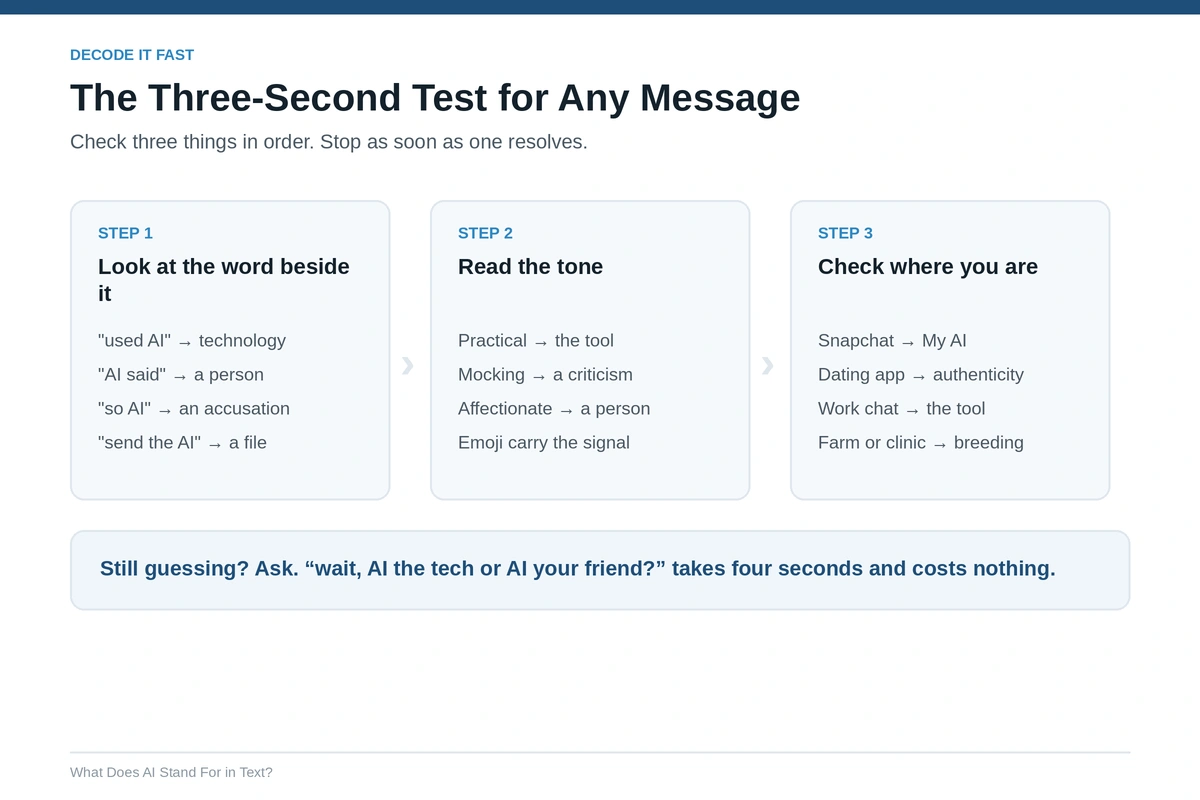
You do not need to memorize a list. Check three things in order and stop as soon as one resolves.
Step one: look at the word beside it
Grammar settles most cases on its own.
- “used AI,” “the AI,” “AI wrote,” “AI-generated” – technology.
- “AI said,” “AI is picking me up,” “AI’s birthday” – a person.
- “so AI,” “sounds AI,” “very AI” – an accusation about content.
- “send the AI,” “open the AI file” – an Adobe Illustrator document.
Step two: read the tone
Practical and neutral points to the tool. Mocking, especially alongside a skull emoji, a crying-laughing face, or a screenshot, points to the accusation. Affectionate or logistical points to a person.
Step three: check where you are
The platform narrows it fast. Snapchat means My AI. A dating app means an authenticity complaint. A work channel means the tool your company pays for. A design freelance thread means the file. A farm or clinic thread means insemination.
When to just ask
If all three steps leave you guessing, ask. Waitit, AI the tech, or AI, your friend?” takes four seconds and costs you nothing. Guessing wrong on a message about a person is far more awkward than a one-line clarification.
Claimed Meanings That Do Not Hold Up
Search this question, and you will meet a wall of near-identical pages listing extra definitions. Several are worth flagging, because they appear confident and are not supported.
- “Aight”, presented on multiple slang sites as a casual agreement used by AI. It does not appear in established slang references, and “aight” already has its own spelling that people actually type. No usage record supports it.
- “Am interested” / “Always interested, circulated mainly on pages targeting romantic-interpretation searches. There is no documented record of either. They look like filler written to lengthen thin articles.
- Confusion with IA: IA in texting is commonly read as “I agree.” AI and IA are different abbreviations and should not be treated as interchangeable.
The honest position: artificial intelligence, plus a small set of documented alternatives, plus initials. Anything beyond that deserves a source before you believe it.
How to Reply Without Getting It Wrong
Four common messages and the response each one is actually asking for.
- “Did you use AI for this?” A direct question about process. Answer it plainly. Hedging reads worse than either yes or no.
- “This is so AI.” A comment on style, not software. Ask which part felt off. It is usually the rhythm or the empty adjectives.
- “AI keeps messaging me.” On Snapchat, this is My AI in the chat list. They want to know how to manage it, not what a chatbot is.
- “AI said 7.”A person relayed information. Ask who, and do not agree to plans you have not verified.
Final Words
AI stands for artificial intelligence. That answer is correct nearly every time, and it is where you should start. What makes the abbreviation slippery is not competing definitions; it is competing jobs. The same two letters name a technology in one message, criticize a piece of writing in the next, refer to a chatbot inside an app in a third, and stand in for a person’s initials in a fourth. Grammar, tone, and platform sort them out in seconds. Be skeptical of long lists of extra slang meanings. Most of what circulates online has no usage behind it. The real set is short: artificial intelligence, a content criticism, a named assistant, initials, and a handful of professional uses like Illustrator files and artificial insemination.
And when the letters genuinely do not fit, ask. One short question beats a long misunderstanding.
Frequently Asked Questions
What does AI stand for in text messages?
AI stands for artificial intelligence in the vast majority of text messages. It can also refer to a specific chatbot such as Snapchat’s My AI, describe content that reads machine-generated, or represent a person’s initials. The surrounding sentence almost always makes the intended meaning clear.
Does AI mean “as if” in texting?
It can, but rarely. Internet slang dictionaries, including NetLingo, have documented AI as shorthand for “as if,” used to express disbelief. The usage dates from an earlier era of instant messaging and is uncommon today, so treat artificial intelligence as the default unless the sentence clearly reads as sarcasm.
What does it mean when someone says my text sounds like AI?
They mean the writing feels generic, over-polished, or machine-written rather than personal. It is a comment on style, not an accusation about software. Shorter sentences, specific details, and fewer stock phrases usually fix the impression.
Why does my friend’s name look like AI in my messages?
Because a capital I and a lowercase L look identical in most phone fonts. The name “Al” renders on screen as what appears to be “AI.” If the message makes sense with a person in that slot, it is almost certainly a name and not an acronym.
Does AI mean something different on Snapchat?
On Snapchat, AI usually refers to My AI, the built-in chatbot that appears in your chat list. So “AI replied to me” means the app feature, not artificial intelligence in the abstract. The underlying meaning of the letters is the same; the reference is just narrower.
Can AI be a person’s initials?
Yes. A.I. is an ordinary set of initials, and Ai is also a common given name of Japanese, Chinese, and Vietnamese origin, pronounced like “eye.” Contacts saved under those letters appear as AI in message headers and screenshots.
For any suggestions or changes, please contact us.