What does AI stand for in business? In nearly every case, it stands for artificial intelligence, software that handles tasks that used to require human judgment. That is the two-second answer, and for most conversations it is the only one you need. The reason people keep searching for it is that the expansion does not settle anything. “Artificial intelligence” has become one of the least precise terms in American business. The same two letters get stapled to a $6-a-month email filter and to a supply-chain forecasting platform with a seven-figure implementation cost. When a sales rep says their product is AI-driven, the letters tell you nothing about whether the thing works. So this guide answers the acronym question first, then the harder question underneath it: what the person in front of you actually means when they say it, and how to tell when they are stretching the word past its breaking point.
The Short Answer: AI Stands for Artificial Intelligence
Artificial intelligence is the field of building software that performs tasks associated with human cognition, recognizing patterns, understanding language, making predictions, and generating content. The term dates to a 1956 workshop at Dartmouth College, where researchers including John McCarthy and Marvin Minsky coined it. It is not new. What is new is that it works well enough to sell.
What Artificial Intelligence Means in a Business Context
Inside a company, AI almost always refers to one of four practical things:
- Which customers will churn, which invoices will be paid late, how much inventory to hold in March.
- Sorting support tickets by urgency, flagging transactions as suspicious, tagging resumes by skill.
- Drafting emails, writing code, summarizing a 40-page contract into a paragraph.
- Pulling structured data out of unstructured mess, invoices, PDFs, call transcripts, scanned forms.
If a tool being sold as AI does not clearly do one of those four, it is worth asking what it does do. That question alone filters out a surprising amount of noise.
Why the Definition Keeps Sliding
A long-running observation in the field, sometimes called the AI effect: once a capability becomes reliable and common, people stop calling it AI. Spam filtering, spell check, credit scoring, and route optimization were all considered artificial intelligence when they arrived. Now they are just software.
That drift cuts the other way too. Because “AI” signals sophistication, ordinary conditional logic gets rebranded upward. Both pressures act on the same word at the same time, which is exactly why the acronym alone cannot tell you much.
What Does AI Stand For in Business Besides Artificial Intelligence?
The abbreviation is not exclusive. In a handful of business settings, AI means something else entirely, and reading it as artificial intelligence will send you in the wrong direction.
Appreciative Inquiry – HR and Organizational Development
This is the most common non-technical meaning, and the easiest to trip over. Appreciative Inquiry is a change-management method developed by David Cooperrider and Suresh Srivastva at Case Western Reserve University in the 1980s. Instead of auditing what is broken, it builds change around what already works well in an organization.
If you see “AI” on a leadership offsite agenda, in a culture consulting proposal, or in an OD workshop title, check before assuming anyone is talking about algorithms. An HR consultant running an “AI summit” is very likely running an Appreciative Inquiry summit.
Accrued Interest – Finance and Accounting
In bond markets and on accounting worksheets, AI is standard shorthand for accrued interest: interest earned but not yet paid or received. You will see it in bond pricing conventions, where the quoted clean price excludes AI, and the invoice price includes it.
Adobe Illustrator and the .ai File
When a designer, printer, or agency asks you to “send the AI file,” they want an Adobe Illustrator vector document. This request comes up constantly in branding, packaging, and print production. It has nothing to do with machine learning, and confusing the two makes for an awkward email.
Active Ingredient, Analog Input, and Artificial Insemination
Three narrower industry uses worth recognizing:
- Active Ingredient. Pharmaceuticals, agrochemicals, and consumer packaged goods: the component that does the work in a formulation.
- Analog Input. Manufacturing and industrial controls: an input channel on a PLC that reads a continuous signal such as pressure or temperature.
- Artificial Insemination. Livestock and agribusiness, where AI is a routine, decades-old breeding term with no ambiguity at all inside that industry.
There is also a quirk of internet real estate worth knowing: the .ai domain extension is the country-code top-level domain for Anguilla, a British Overseas Territory in the Caribbean. Its resemblance to the acronym is a coincidence that turned into a windfall for a small island territory.
How to Tell Which AI Someone Means
Context resolves it almost instantly once you know what to watch for.
Three Context Clues That Settle It Fast
- Who is speaking. Engineering, product, and marketing mean artificial intelligence. HR and organizational consultants may mean Appreciative Inquiry. Treasury and fixed income mean accrued interest. Creative and print production mean Illustrator.
- What verb follows it? AI that “trains,” “predicts,” or “generates” is artificial intelligence. AI that gets “sent,” “opened,” or “exported” is a file. AI that “accrues” is interest.
- Whether it takes an article. “An AI” or “the AI” almost always means artificial intelligence. Bare “AI” in a financial or design context is more likely one of the others.
How Many U.S. Businesses Actually Use AI?
This is where the vagueness of the term stops being an academic problem and starts distorting real numbers. Two credible sources give wildly different answers, and the gap between them is the most useful thing in this article.
The Census Bureau Says About One in Five
The U.S. Census Bureau runs the Business Trends and Outlook Survey, a biweekly, nationally representative survey of American employer businesses. It asks a deliberately narrow question: did this business use AI to help produce goods or services in the past two weeks?
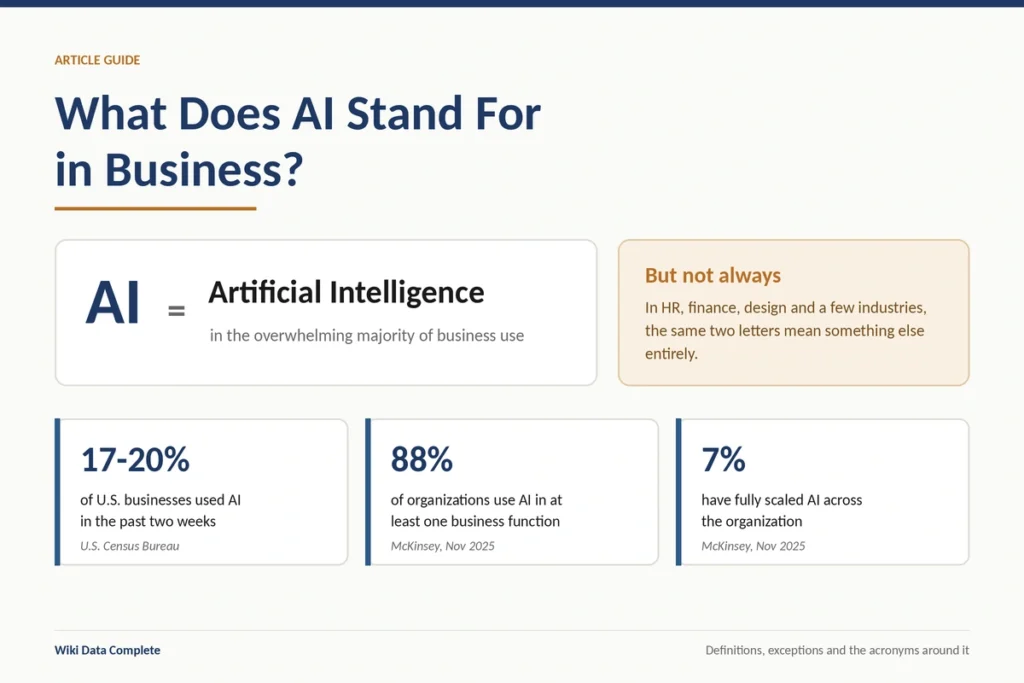
Reviewing data collected from December 14, 2025 through May 3, 2026, the Census Bureau found overall AI use hovering between 17% and 20%, with 20% to 23% of businesses expecting to use it within six months. Adoption climbed sharply with company size, roughly 37% among businesses with at least 250 employees and about 32% among firms with 100 to 249 employees.
McKinsey Says 88 Percent
McKinsey’s State of AI report, published November 5, 2025 and drawing on 1,993 respondents across 105 countries, reported that 88% of organizations use AI in at least one business function, up ten percentage points from 2024. But the same report found only 7% of respondents said AI had been fully scaled across their organization.
Why the Two Numbers Disagree
Both figures are honestly collected. They diverge because they are measuring different things:
- Who answers. Census surveys a broad cross-section of all U.S. employer businesses, including the plumbing contractor and the two-location restaurant group. McKinsey surveys respondents at organizations engaged enough with AI to participate in a survey about it.
- What counts. “Used AI to produce goods and services in the past two weeks” is a far higher bar than “uses AI in at least one business function.”
- What scale means. One marketing manager using a chatbot can make a company an AI adopter under a loose definition, while changing nothing about how the business runs.
The practical takeaway: when you see an AI adoption statistic, the number tells you less than the question behind it. Ask what counted as AI and who was asked. Most eye-catching adoption figures are measuring experimentation, not transformation.
The AI Acronyms You Will See Alongside It
Once you are in an AI conversation, a cluster of related abbreviations shows up. Here is the working set, in plain language.
| Acronym | Stands For | What It Means in Practice |
| ML | Machine Learning | Systems that improve at a task by finding patterns in data instead of following hand-written rules. Most business “AI” is this. |
| DL | Deep Learning | A subset of ML using layered neural networks. Powers image recognition, speech-to-text, and modern language models. |
| NLP | Natural Language Processing | Getting software to read, sort, and respond to human language. Think ticket routing and sentiment scoring. |
| Gen AI | Generative AI | AI that produces new output: text, images, code, audio. The category ChatGPT and its competitors created. |
| LLM | Large Language Model | The engine behind most gen AI text tools. Trained on huge text corpora to predict likely next words. |
| RAG | Retrieval-Augmented Generation | Feeding a language model your own documents at question time so answers cite your data, not the open internet. |
| RPA | Robotic Process Automation | Rule-based software that clicks through repetitive screens. Frequently mislabeled as AI. It is not. |
| AGI | Artificial General Intelligence | Hypothetical AI matching human ability across any task. Does not exist. Treat vendor claims about it as marketing. |
| AIaaS | AI as a Service | Renting AI capability through an API instead of building or hosting models yourself. |
| ADMT | Automated Decision-Making Technology | The term U.S. state regulators are moving toward, because it is harder to argue about than “AI.” |
ML, DL, and NLP Are Not Interchangeable With AI
The nesting matters. Artificial intelligence is the broad field. Machine learning is a subset of AI. Deep learning is a subset of machine learning. Natural language processing is an application area that draws on all three. Vendors use them interchangeably; specifications should not.
Gen AI, LLM, and RAG
Generative AI is the category most people now picture when they hear “AI” at all. A large language model is the engine underneath it. RAG is the technique that connects that engine to your own documents, which is what turns a general-purpose chatbot into something that can answer questions about your specific contracts, policies, or product catalog.
RPA Is Not AI
Robotic process automation follows explicit rules a human wrote. If the screen layout changes, it breaks. Machine learning adapts from data. The distinction matters commercially, because RPA is mature, cheap, and predictable, while AI projects carry real variance in outcome. A vendor blurring the two is either imprecise or selling.
AGI Is Not Here Yet
Artificial general intelligence describes a system matching human capability across arbitrary tasks. No such system exists. If it appears in a sales deck for software you can buy today, that is a signal about the vendor, not the product.
Where AI Shows Up in a Normal Business Week
Abstract definitions are less useful than knowing where the technology actually lands. Function by function:
Marketing and Sales
Draft generation for email and ad copy, lead scoring based on historical conversion patterns, call transcript summarization, and audience segmentation. This function tends to adopt first because the cost of a bad output is low; a weak draft gets rewritten, not shipped.
Customer Support
Ticket classification and routing, suggested replies for agents, and knowledge base search. The reliable wins here are assistive rather than autonomous: the model drafts, a human sends. Fully automated frontline support remains the place where companies most often overreach.
Finance and Accounting
Invoice data extraction, anomaly detection in expense reports, transaction categorization, and cash-flow forecasting. Fraud detection in card networks has used machine learning for decades; it was simply never marketed as AI.
HR and Recruiting
Resume parsing, job description drafting, and scheduling. This is also the function carrying the most legal exposure, because employment decisions are precisely what emerging U.S. state law targets. Treat any AI touching hiring as a compliance question first and a productivity question second.
Operations and Supply Chain
Demand forecasting, predictive maintenance on equipment, and route optimization. These are the least glamorous deployments and frequently the ones with the clearest measurable return, because the baseline they replace is a spreadsheet someone maintains by hand.
What AI Does Not Stand For: Four Common Misreadings
AI Is Not a Synonym for Automation
Automation means a task runs without a person. It can be a scheduled script, a macro, or a formula. AI means the system learns from data. Plenty of valuable automation contains no AI at all, and plenty of AI requires more human oversight than the manual process it replaced.
“AI-Powered” on a Product Page Often Means Very Little
The phrase is unregulated in marketing copy. It can describe a genuinely trained model or a single API call to someone else’s model wrapped around a form. The tell is specificity: real capability comes with detail about what the model does, what it was trained on, and where it fails.
AI Is Not a Department
Organizations that treat AI as a team rather than a capability tend to produce demos that never reach operations. McKinsey’s finding that 88% of organizations use AI while only 7% have scaled it describes exactly this pattern — pilots that live somewhere adjacent to the business rather than inside it.
AI Is Not Always the Expensive Option
The reverse assumption causes as much damage. Many capabilities that required a data science team five years ago are now an API call costing fractions of a cent. The expensive part of an AI project is rarely the model. It is data cleanup, integration, and change management.
How to Use the Term Correctly in Business Writing
Spell It Out Once, Then Name the Capability
Standard practice in American business writing: write “artificial intelligence (AI)” on first reference, then use AI thereafter. But the stronger move is to skip the abstraction entirely. “We use AI for forecasting” says less than “we use a demand model trained on three years of order history.” Specificity is more persuasive than the acronym, and it is much harder to fake.
Watch the Legal Definitions – They Are Moving Fast
Regulators have run into the same vagueness problem and are quietly abandoning the term. Colorado enacted the first comprehensive U.S. state AI law, SB 24-205, in May 2024. It never took effect. Its start date was pushed from February 1, 2026, to June 30, 2026; a federal court stayed enforcement on April 27, 2026, and on May 14, 2026, Governor Jared Polis signed SB 26-189, which repealed and replaced it with a narrower disclosure framework effective January 1, 2027.
The substantive detail for anyone writing about this: the replacement law is built around “automated decision-making technology,” not “artificial intelligence.” That shift is deliberate. Regulators found ADMT easier to define and harder to litigate than AI. Expect other states to follow the same wording, and expect compliance obligations to attach to what a system decides rather than what the vendor calls it.
Ask the Vendor Three Questions
When someone claims their product uses AI, three questions separate substance from positioning:
The Three Questions
- What specifically does the model predict, classify, or generate? A vague answer here usually means there is no model.
- What data was it trained on, and does it learn from our data or a general corpus? This determines whether accuracy improves with use.
- What does it do when it is wrong, and how would we know? Every model fails. Vendors who have thought seriously about failure modes will have a ready answer.
Final Words
AI stands for artificial intelligence in the overwhelming majority of business conversations, with real exceptions in HR, finance, design, and a few specialized industries where the same two letters mean something completely different. But the acronym was never the hard part. The hard part is that “AI” now covers a range from a spreadsheet formula with good marketing to genuinely novel capability, and the word itself does not distinguish between them. The Census Bureau counts about one in five U.S. businesses using it. McKinsey counts 88%. Both are right, because they are asking different questions. The most useful habit is to translate the acronym into a verb every time you encounter it. What does this thing predict, classify, generate, or extract? Anyone selling real capability can answer that in one sentence. Anyone who cannot is selling the letters.
Frequently Asked Questions
Does AI always mean artificial intelligence in business?
No, though it does the vast majority of the time. In HR and organizational development, AI often means Appreciative Inquiry. In finance and bond markets, it means accrued interest. In design and print production, it means an Adobe Illustrator file. Context, especially who is speaking and what verb follows the acronym, resolves it quickly.
What is the difference between AI and machine learning?
Artificial intelligence is the broad field of building software that performs cognitive tasks. Machine learning is a subset of it: systems that improve at a task by finding patterns in data rather than following rules a programmer wrote. Nearly all AI currently deployed in business is machine learning, which is why the terms get used interchangeably even though they are not equivalent.
How many U.S. businesses use AI right now?
It depends entirely on the definition. The U.S. Census Bureau’s Business Trends and Outlook Survey found AI use between 17% and 20% of American businesses across data collected from December 2025 through May 2026, rising to roughly 37% among firms with 250 or more employees. McKinsey’s November 2025 State of AI report put the figure at 88% of organizations using AI in at least one business function, but only 7% had fully scaled it.
Is RPA the same thing as AI?
No. Robotic process automation executes explicit rules written by a person and breaks when conditions change. AI systems learn patterns from data and generalize to situations they were not explicitly programmed for. Many vendors market RPA as AI. The distinction matters because the two have very different costs, risks, and failure behaviors.
Why does the .ai domain extension exist?
The .ai extension is the country-code top-level domain assigned to Anguilla, a British Overseas Territory in the Caribbean. It predates the current AI boom and has nothing to do with artificial intelligence. The coincidence has made it a valuable registry as technology companies compete for the extension.
What should I ask a vendor claiming their product uses AI?
Ask what the model specifically predicts, classifies, or generates; what data it was trained on and whether it learns from your data; and what happens when it produces a wrong answer. Vendors with real capability answer all three concretely. Vague responses generally indicate marketing language attached to conventional software.
For any suggestions or changes, please feel free to contact us.